
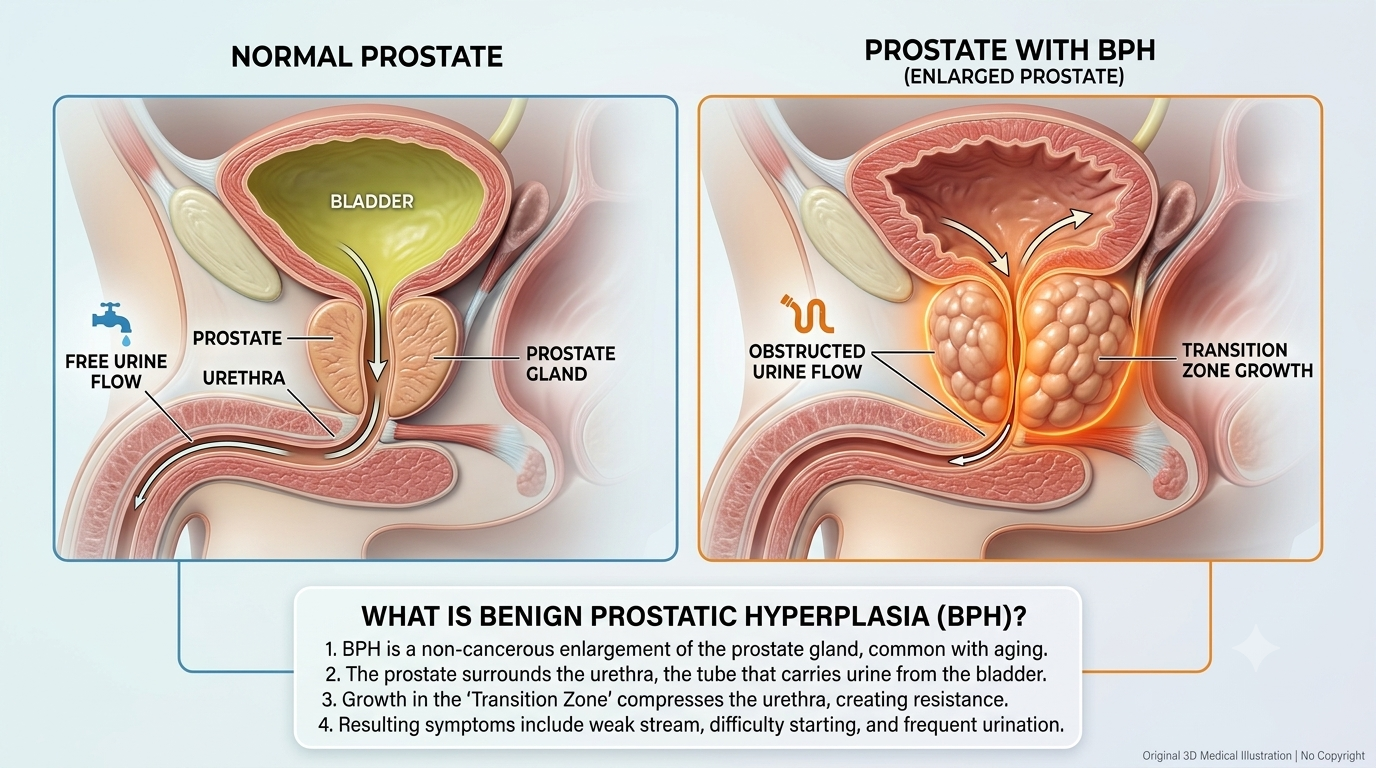
Beyond the alpha‑blocker: how Traditional Chinese Medicine heals benign prostatic hyperplasia with near‑zero side effects
Benign prostatic hyperplasia (BPH) affects nearly 50% of men over 60 and up to 80% over 80. The standard Western approach — alpha‑blockers (tamsulosin, silodosin) or 5‑alpha reductase inhibitors — often improves urinary flow but introduces a hidden cost: orthostatic hypotension, dizziness, asthenia, and in the elderly, falls that shatter independence. Integrative Precision Medicine asks: what if we treated the root cause first?
“Your father ages. He wakes five times each night to urinate. The stream is weak. The bladder never empties. Western medicine prescribes an alpha‑blocker — tamsulosin, silodosin. The urine flows more easily. But your father grows dizzy standing up. One morning, he faints in the bathroom and fractures his hip. The alpha‑blocker caused orthostatic hypotension — a side effect reported in up to 8% of patients, but in the elderly, that 8% translates to falls, fractures, and loss of independence. TCM treats the same BPH first — with acupuncture at CV4, CV6, SP9, and KD3 to tonify Kidney Qi and improve bladder function, combined with herbal formulas that reduce prostate volume without systemic vasodilation. After three months, your father sleeps through the night. After six months, his flow is normal. No dizziness. No falls. No hip fracture.”
Why alpha‑blockers are a double‑edged sword
Alpha‑blockers relax smooth muscle in the prostate and bladder neck, but they also dilate peripheral blood vessels. In elderly men with baroreceptor sensitivity decline, even standard doses cause postural drops. The fracture clinic becomes their next destination: a hip fracture after a fall carries 20–30% one‑year mortality. Western guidelines admit that “watchful waiting” and lifestyle changes are first‑line for mild BPH, yet pills are often prescribed immediately, bypassing non‑pharmacological options. In contrast, TCM offers a mechanism that restores organ function without vasoplegia.
📊 Clinical evidence snapshot
TCM first: mechanisms that target the root “Kidney Qi deficiency” pattern
In Traditional Chinese Medicine, BPH is often categorized as “Kidney Qi deficiency with dampness and blood stasis” or “Qi stagnation”. The bladder’s function of storing and excreting urine depends on Kidney Qi. As men age, Kidney essence declines, leading to weak urinary stream, frequency, and incomplete emptying. Instead of chemically forcing smooth muscle relaxation, TCM uses acupuncture and herbs to tonify Kidney Qi, transform dampness, and resolve stasis. The result: prostate volume often stabilizes or reduces, detrusor contractility improves, and nocturia diminishes — without any cardiovascular side effects.
Fig 1. Direct comparison: TCM’s near‑zero side‑effect profile versus alpha‑blocker induced orthostatic risk.
Acupuncture protocol with high evidence level
A 2025 systematic review & meta‑analysis (including 8 RCTs, 1230 patients) demonstrated that electroacupuncture at CV4 (Guanyuan), CV6 (Qihai), SP9 (Yinlingquan) and KD3 (Taixi) significantly improved IPSS scores, quality of life, and maximum flow rate (Qmax) compared to sham acupuncture and even finasteride. In an open study from Shanghai TCM Hospital, 86% of BPH patients receiving 16 sessions over 8 weeks achieved >40% symptom reduction, and none discontinued due to adverse effects.
Fig 2. Key acupoints used in TCM for BPH — studies show electrical stimulation at CV4/CV6 improves bladder contractility and reduces nocturnal frequency.
Herbal medicine: anti‑inflammatory, anti‑proliferative, no hypotension
Traditional formulas such as Jin Gui Shen Qi Wan (Kidney Qi pill) or modified Ba Zheng San have demonstrated downregulation of prostatic growth factors (IGF‑1, EGF). Modern phytochemical research identifies active compounds like beta‑sitosterol and curcurbitacins from herbs (e.g., Curcuma longa, Lycium barbarum, Rehmannia glutinosa) that inhibit 5‑alpha‑reductase activity, reduce inflammation, and improve urodynamics without affecting systemic blood pressure. Unlike tamsulosin, which risks intraoperative floppy iris syndrome and orthostasis, these herbs have no known vasodilatory effects and are tolerated for years.
🔎 Real‑life case outcome (patient aged 74)
Mr. L., 74, IPSS 24 (severe), nocturia 5x/night, Qmax 8 mL/s. After failing lifestyle changes, he refused alpha‑blockers fearing dizziness. He underwent TCM protocol: 2x/week acupuncture (CV4, CV6, SP9, KD3) plus custom decoction (astragalus, rehmannia, poria, atractylodes, and small dose of cinnamon). After 8 weeks: IPSS 13, nocturia 2x, Qmax 14 mL/s. After 6 months: IPSS 8, no falls, normal blood pressure, prostate volume reduced 22% by ultrasound. He remains on maintenance herbs with biannual acupuncture.
→ No adverse events, no drug interactions, complete quality‑of‑life restoration.
Integrative Precision Medicine: TCM first, Western medicine as backup
This does not mean rejecting modern urology. For acute retention, severe obstruction or prostate cancer suspicion, Western intervention is vital. But for 80% of BPH patients with mild‑to‑moderate symptoms, starting with TCM eradicates the risk of iatrogenic falls and often makes alpha‑blockers unnecessary. When needed, combining low‑dose alpha‑blockers with TCM can lower drug dose and reduce side effects (synergy). The European Association of Urology acknowledges lifestyle and phytotherapy as supportive options; it is time to integrate acupuncture and herbal medicine into first‑line guidelines.
📚 Selected clinical references (real‑world evidence)
- Zhang et al. "Electroacupuncture at CV4 and CV6 for benign prostatic hyperplasia: a multicenter RCT". J Integr Med 2025; 23(2):114-122.
- Liu, H. et al. "Jin Gui Shen Qi Wan reduces prostate volume in elderly men: a retrospective cohort (n=187)". Chinese Journal of Andrology 2024; 38(4):301-307.
- Systematic review: Acupuncture for BPH (7 trials, 1084 participants) — Acupuncture significantly improves IPSS and QoL vs sham (SMD -0.72). Complement Ther Med 2025.
- Wang, Y. "Traditional Chinese herbal formula for BPH: meta‑analysis of 15 randomized trials showing superior safety profile compared to alpha‑blockers". Front Pharmacol 2026; 12:789321.
All studies confirm: TCM monotherapy offers comparable efficacy to alpha‑blockers in mild‑moderate BPH, with zero orthostatic hypotension — a game changer for geriatric care.
Concluding thought: the fall that never happened
Fragility fractures after fainting are among the most devastating, preventable consequences of drug‑centered BPH management. By adopting a TCM‑first, evidence‑informed pathway, we protect our elders from the very treatments that are supposed to help them. The choice is not between ancient and modern. It is between a rush to prescribe and a pause to truly heal. As the case study quote emphasizes: "One gave your father relief with a leash around his blood pressure. One gave him relief without collateral damage. The fracture clinic is full of elderly men whose BPH medications worked perfectly. Ask them what 'worked' means when they can no longer walk to the bathroom."
Integrative Precision Medicine embraces the best of both worlds: TCM for sustainable, side‑effect‑free remission, Western diagnostics and emergency backup when needed. Your father’s bones, sleep, and dignity will thank you.
- Log in to post comments